


October 25, 1965
Crew: Wally Schirra, Tom Stafford
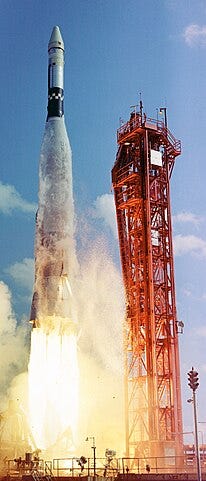
Gemini 6 was originally focused on the first docking attempts with an Agena Target Vehicle. Schirra and Stafford were aboard their spacecraft when the Agena was launched. The Atlas booster worked flawlessly, but the Agena’s secondary engines failed to separate it from the Atlas. So, when the Agena’s primary engine fired, the stack exploded, falling in pieces to the ocean below. Fifty minutes later, the Gemini 6 launch was canceled.
Within hours, the NASA team was hashing out ideas for an alternative mission. McDonnell manager suggested the idea of launching Gemini 6 during the long-duration flight of Gemini 7. The next day, senior NASA leaders agreed to what became known as Gemini 76. Flight planners and engineers scrambled to work out the details, with the goal of launching Gemini 6 seven days after Gemini 7. Having to deal with two launches and flights was going to put NASA to the test.
First off, both launches would have to use the same launching facility, Pad 19. The ground crews would have to move faster than ever before clearing the Pad, erecting the Gemini 6 stack and running through the preflight tests. Mission planners had to crunch the numbers and develop the necessary flight plans. And the Flight Directors had to figure out how to manage and communicate with two spacecraft at the same time.
The Agena Target Vehicle
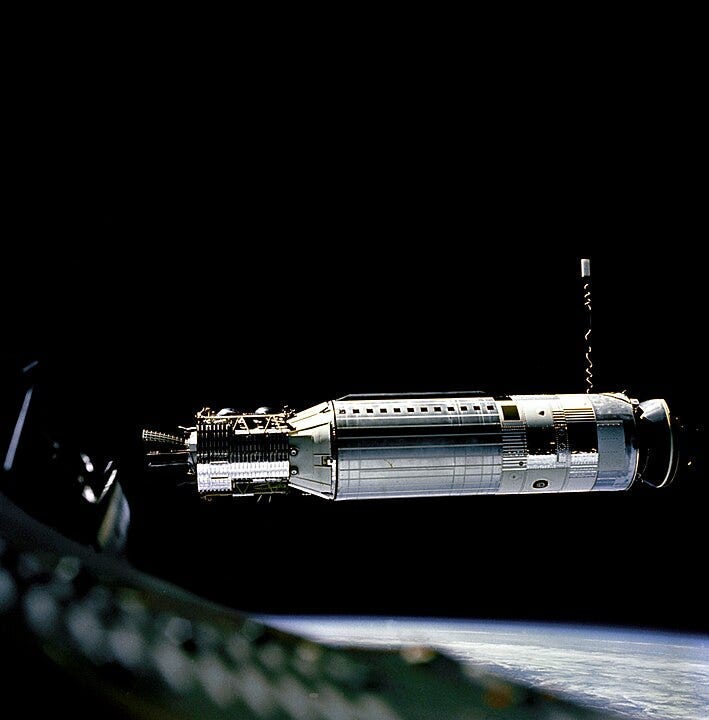
Rendezvous and docking were two of the skills NASA and its astronauts needed to develop before they became vital during Apollo. The Gemini spacecraft had no docking system, so NASA planners devised a plan to use a modified version of the Agena-D and a docking adapter. The unmanned Agena Target Vehicle (ATV) was to be launched atop an Atlas booster. One orbit later, the Gemini-Titan would be launched. The two spacecraft would rendezvous, and then the Gemini would dock.
The astronauts would then be able to control the Agena. They would conduct a series of tests which included using the Agena’s engine to change the combo’s orbit and using the Agena’s attitude control system.
When the first Agena failed, NASA had McDonnell build a backup, called the Augmented Target Docking Adapter.